Short-Term Cravings vs Long-Term Gains — Choose One

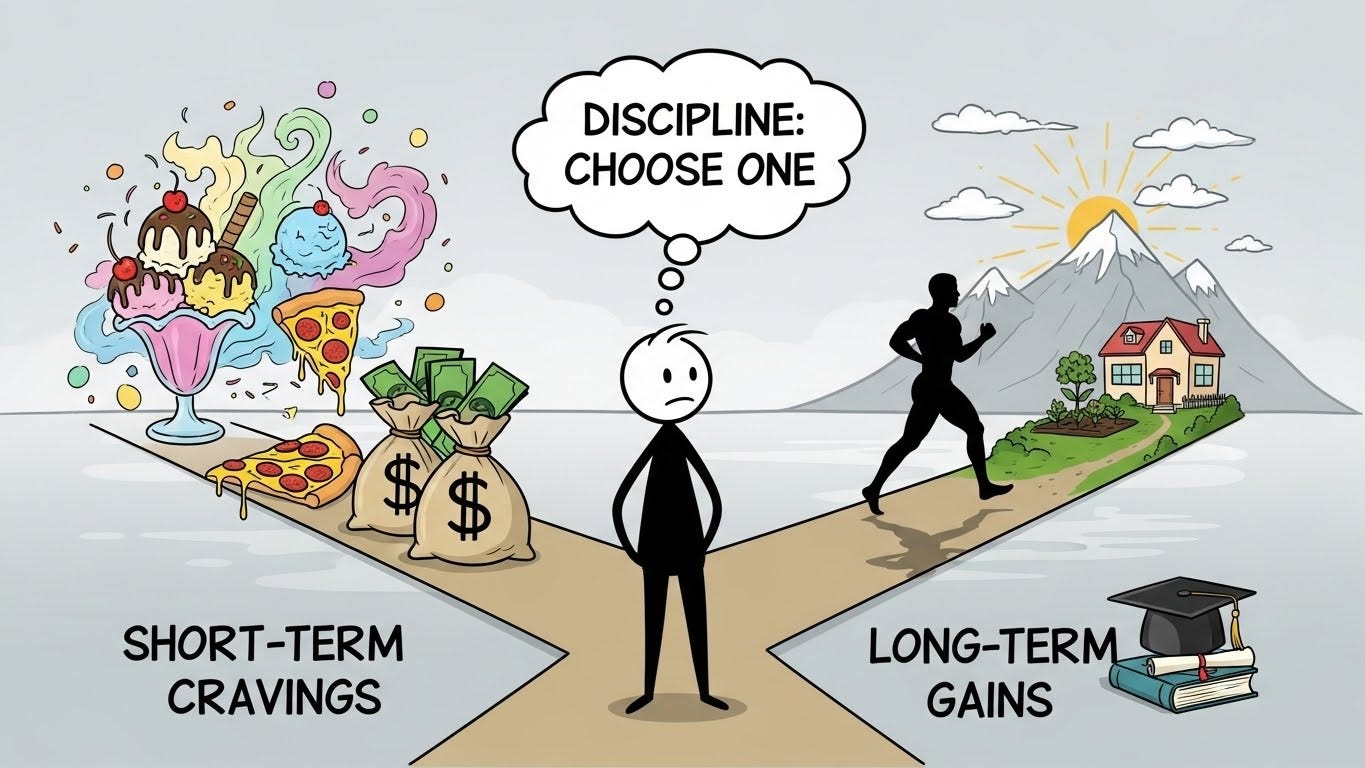
We all know the feeling.
It’s 6 AM, and your alarm goes off. You said you’d wake up early to hit the gym. But your bed is warm, your pillow is comfortable, and you want five more minutes. So you take them. Then another ten. Before you know it, you’re scrolling through Instagram in bed, the gym window closed, and you’re telling yourself, “I’ll go tomorrow.”
You want to be fit. But you wanted to sleep more, right now.
This isn’t a willpower problem. It’s not laziness. It’s a fundamental misalignment between the decisions you make in the moment and the outcomes you actually want to create. And once you understand this gap, you can finally close it.
The Problem: Your Brain’s Reward System Is Broken
Here’s what’s happening at a neurological level: your brain is rewarding the wrong behaviour.
Immediate gratification is wired into your survival instincts. Thousands of years ago, humans evolved to want things now — because “now” was the only guarantee you had. Your ancestors didn’t know if they’d see tomorrow, so they ate the food, took the rest, and avoided the risk.
But you live in a world where:
Food is abundant (and engineered to be irresistible)
Comfort is built into your environment
Distractions are one click away
Tomorrow is almost guaranteed
Your brain hasn’t evolved past these ancient reward systems. So when you’re faced with a choice between the discomfort of discipline now and the pleasure of comfort now, your brain defaults to comfort.
The tragedy? That comfort costs you the actual goal you want.
The Math of Delayed Gratification
Think of it this way:
What you want now: 8/10 satisfaction (immediate relief, comfort, pleasure)
Cost: You miss your long-term goal (fitness, financial freedom, creative fulfilment, etc.)
What you want most: 9/10 satisfaction (the identity, capability, and life that comes with achieving your goal)
Price: Discomfort right now, for a concentrated period
Most people choose 8/10 today over 9/10 in six months, because the brain doesn’t value future rewards the way it values present ones.
But here’s the secret: discipline is simply choosing to value future rewards the same way you value present ones.
The Real Definition of Discipline
Discipline isn’t punishment. It’s not about suffering or denying yourself joy.
Discipline is the skill of choosing between two things you want — and consistently picking the one that actually matters.
When you reframe it this way, everything changes. You’re not being “disciplined” by waking up early. You’re choosing between:
Waking up early (short-term discomfort, long-term identity as someone fit/healthy)
Sleeping in (short-term comfort, long-term identity as someone who never quite gets there)
Both choices have consequences. Discipline is just picking the consequences you actually want to live with.
The Framework: How to Bridge the Gap
Closing the gap between what you want now and what you want most requires three things:
1. Make the Future Tangible
Your brain doesn’t value abstract goals. “Get fit” is too distant, too vague. Your brain wants concrete, immediate rewards.
Solution: Create visible progress markers.
Instead of “I want to get fit,” reframe it as “I want to work out 4 times this week and feel the soreness that means I’m getting stronger.” Instead of “I want to save money,” reframe it as “I want to watch my savings account hit $5,000 this month.”
Track what matters. Visualization boards, habit trackers, progress spreadsheets — these work because they make the future visible and real in the present moment.
When you can see tangible progress, your brain starts to value the future reward as highly as the present one.
2. Stack the Friction Against the Wrong Choice
If the immediate gratification is too easy, you lose every time.
Solution: Increase friction on the low-value choice and decrease friction on the high-value choice.
Want to stop scrolling Instagram? Delete the app from your phone. Want to wake up early? Put your alarm across the room. Want to eat healthier? Don’t bring junk food into your house.
This isn’t about willpower — it’s about smart design. You’re not denying yourself; you’re just making the wrong choice slightly harder and the right choice slightly easier.
The compound effect of small friction changes is massive.
3. Redefine Your Identity
This is the most powerful lever.
People who succeed long-term don’t rely on motivation. They rely on identity.
Solution: Stop thinking of discipline as something you do. Start thinking of it as something you are.
Don’t say “I’m trying to work out” (this is fragile — one missed day and you quit). Say “I’m someone who works out” (this is stable — missing one day doesn’t change your identity).
When you internalize a new identity, discipline shifts from exhausting willpower to automatic behaviour.
You don’t need willpower to brush your teeth. You do it because you’re “someone who brushes their teeth.” Same mechanism.
The Practical Path Forward
Here’s what this looks like in practice:
Step 1: Choose One Goal
Pick what you want most — just one for now. Not five. One. Maybe it’s fitness, maybe it’s finishing your book, maybe it’s learning a skill.
Step 2: Map the Gap
What do you want now that’s competing with your goal? Name it specifically. Is it sleep? Comfort? Scrolling? Social approval?
Step 3: Make the Trade Visible
Every time you face that choice, acknowledge it consciously. “I’m choosing comfort now, which means I’m choosing to stay where I am with my goal.” Or “I’m choosing discomfort now, which means I’m choosing to move toward my goal.”
This consciousness alone shifts behaviour.
Step 4: Design Your Environment
Make your goal-behaviour the path of least resistance. If you want to read more, put the book on your pillow. If you want to meditate, set up a designated spot. If you want to code, have your project already open when you sit down.
Step 5: Celebrate the Friction
Here’s the psychological hack: the discomfort is the point. When you choose discomfort now for something you want most, that’s when you’re building discipline. That’s when you’re upgrading your identity.
Start celebrating that moment of choosing the hard thing. “I felt like sleeping in, but I went to the gym anyway. That’s who I’m becoming.”
Why This Actually Works
Discipline isn’t a fixed resource that runs out. It’s a skill that strengthens with use.
Every single time you choose what you want most over what you want now, you’re:
Training your brain’s reward system to value future outcomes
Building evidence for your new identity
Creating momentum that makes the next choice easier
After 30 days of consistent choices, something magical happens. The discomfort starts to feel like comfort. The choice gets easier. Not because you have more willpower — but because you’ve rewired what your brain sees as the “default” behavior.
You’re not the person forcing themselves to the gym anymore. You’re the person who goes to the gym.
The Truth About Discipline
Discipline isn’t restrictive. It’s liberating.
The person without discipline is actually more constrained — trapped between their competing impulses, never moving toward anything real, always pulled toward whatever feels good in the moment.
The person with discipline has actual freedom. Freedom to build the life they want. Freedom to say no to good things in the service of great things. Freedom to become who they actually want to be.
And that freedom begins the moment you understand: discipline is simply choosing between what you want now and what you want most — and having the courage to pick correctly.
The question isn’t whether you’ll ever feel like doing the hard thing. You won’t always.
The question is: what are you willing to become?
Because that answer will tell you everything about which choice you’ll make.